
David Hockney Biography
Born – 9 July 1937 – Bradford, Yorkshire, UK
Died – 11 June 2026 – London, UK

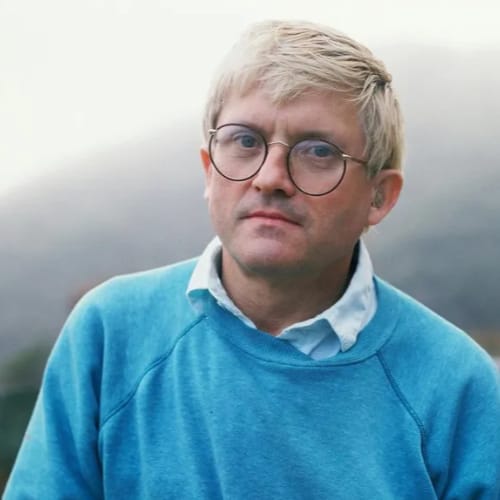
David Hockney Biography
Born – 9 July 1937 – Bradford, Yorkshire, UK
Died – 11 June 2026 – London, UK
Colourful Chronicler of Modern Life
Some of the topics discussed in this Biography
- David Hockney’s time at Art Schools; Bradford and London
- The Impact of California on David Hockey
- David Hockney’s endless experimentation with, ‘joiners’ , fax machines, ipads, stage design.
- Hockney’s return to Yorkshire and his lasting legacy
David Hockney’s Early Life
David Hockney was born on 9 July 1937 in Bradford, West Yorkshire, the fourth of five children in a warm, supportive working class family. His father, Kenneth, was a pacifist and a conscientious objector during the Second World War, a stance that shaped Hockney’s early understanding of independence and conviction. His mother, Laura, a vegetarian and Methodist encouraged his artistic interests from the beginning, never once suggesting that his drawing might be a frivolous pursuit.
Bradford in the 1940s was a city of wool mills and steep terraced streets, the city centre being surrounded on three sides by steep hills. Hockney was a bright boy who loved drawing, he excelled at primary school so much so that at 11 he was awarded a scholarship to Bradford Grammar School. He later described his teenage self as “a Yorkshire boy who loved looking,” and it was in the city’s municipal art gallery, Cartwright Hall that he first encountered the works of Turner, Constable and the French Impressionists. These early visits sparked a fascination with light — something Bradford’s industrial heritage somewhat obscured — and planted the seeds of his lifelong obsession with seeing.
Early Education
By the time he was 14 he was determined to become an artist and told staff at Bradford Grammar School he wished to transfer to Bradford art college. This was refused which led to him adopting a campaign of non-conformity in the classroom, doodling and drawing comic strips in notebooks instead of working at his lessons. He famously told a teacher he would not be attending a maths exam because he intended to become an artist. The teacher replied he would “never make a living at it.” Hockney later said this moment strengthened his resolve. He was finally allowed to leave school at 16 after an agreement between his parents and the headmaster.
Hockney’s Art Education
So, in 1953 Hockney entered the Bradford School of Art, where he studied for four years. He absorbed everything: life drawing, printmaking, design, and the discipline of close observation. He later said, ‘I was interested in everything. I was an innocent boy of 16 and believed everything they told me, everything. If they said, ‘You have to study perspective, I’d study perspective; if they told me to study anatomy. I’s study anatomy. It was thrilling, after the grammar school, to be at a school where I knew I would enjoy everything they asked me to do. I loved it all and used to spend at least twelve hours a day in the art school.’
In 1957 Hockney graduated with a First-Class Diploma with Honours and decided to further pursue his studies in London. He was accepted at both the Royal College of Art and the Slade School of Art. He chose the Royal academy but first had to complete 2 years National Service. He registered as a conscientious objector, echoing his father’s wartime stance and spent his national service working in St Luke’s hospital in Bradford, and the St Helen’s Hospital in Hastings. He didn’t have time to paint but did manage to see two exhibitions that deeply affected him. Alan Davie at the Wakefield Art Gallery in Yorkshire and Jackson Pollock at the Whitechapel gallery in London.
Meeting Friends at the RCA
In 1959 he moved to London and started his study at the Royal College of Art. The RCA was a crucible of talent: R.B. Kitaj, Allen Jones, Derek Boshier and Pauline Boty were among his contemporaries. Hockney thrived in this environment. He formed a deep-seated friendship with the American painter R.B. Kitaj who was quite a bit older than him. It was Kitaj’s encouragement that went some way towards assuaging Hockney’s sense of simply being a north country boy from Yorkshire.
Hockney’s time at the RCA was marked by brilliance and mischief. He refused to complete certain academic requirements, including writing essays, insisting that his art should speak for itself. When the college threatened to withhold his degree, he responded by painting the words “I am a painter” on one of his canvases. The RCA relented, awarding him a diploma in recognition of his exceptional talent.
During these years, Hockney’s work became increasingly autobiographical. He explored themes of desire, identity and personal freedom — subjects rarely addressed openly in British art at the time. Works such as We Two Boys Together Clinging (1961) blended bold graphic forms with coded references to homosexuality, revealing both courage and vulnerability.
In 1962 Hockney exhibited 4 paintings and designed the poster for the Young Contemporaries Exhibition held at the RBA galleries in London.
Hockney Goes Travelling
In 1963, after finishing his studies at the RCA, Hockney travelled to New York, Berlin and Egypt to get inspiration and ideas for illustrations and paintings. In New York he met Andy Warhol, who – along with Roy Lichtenstein – was one of the rising stars of American Pop art. He also became friends with Henry Geldzahler, a curator at the Metropolitan Museum of Art, who encouraged him to visit Los Angeles.
Hockney did travel to Los Angeles in 1964 and the impact was immediate. It was everything he expected and more. He arrived knowing nobody, and yet in the space of 7-days he found a place to stay in Santa Monica, arranged a studio for himself, passed the driving test, bought a car, and even drove to Las Vegas where he won some money gambling. The city’s bright light, modern architecture and relaxed lifestyle transformed his visual language and became an important feature of his work. He later described stepping off the plane in Los Angeles and feeling as though he had “walked into a Matisse painting.”
Early Paintings make a Big Splash
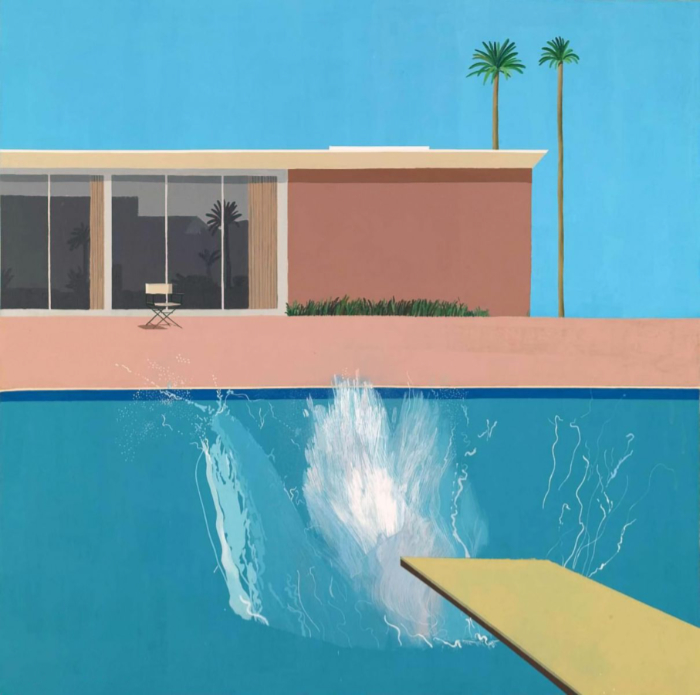
It was here that he developed the swimming pool motif that would make him internationally famous. A Bigger Splash (1967) is perhaps his most iconic work: flat planes of colour, crisp lines and a single splash frozen in time. Beneath its apparent simplicity lies a meditation on presence, absence and the fleeting nature of experience. Perhaps that is what led him so say, ‘I love California; everything is so artificial.’
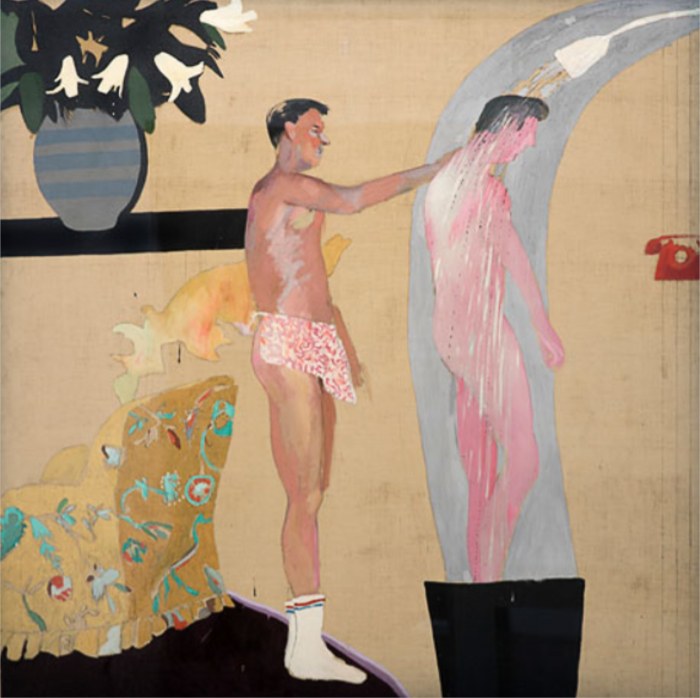
During this period, he also produced intimate portraits of friends and lovers. His double portraits — such as Christopher Isherwood and Don Bachardy (1968) — capture subtle psychological dynamics through posture, gaze and spatial arrangement.
By the early 1970s Hockney had become one of the most celebrated artists of his generation. He returned to Britain frequently, maintaining close ties with the London art world. In 1970 he painted Mr and Mrs Clark and Percy, a portrait of his friends Ossie Clark and Celia Birtwell. The painting is widely regarded as one of the great British portraits of the twentieth century.
Hockney Experiments
Throughout the decade Hockney explored new techniques. He experimented with printmaking, stage design and photography. He was always seeking fresh ways to challenge the boundaries of representation. His set designs for the Glyndebourne Opera Festival demonstrated his flair for theatricality and his love of bold colour.
The 1980s marked another major shift in Hockney’s practice. Dissatisfied with the limitations of single frame photography, he began creating “joiners” — large composite images made from dozens of Polaroid photographs. Hockney argued that traditional photography “forces the eye into a single position,” whereas human vision is fluid, constantly shifting. These works challenged conventional perspective by presenting multiple viewpoints simultaneously, extending the ideas explored by Picasso in Cubism. In 1982 he moved from a Polaroid to a Pentax camera to create more flexibility in his photographic collages. Later that year he had an exhibition of his ‘joiners’ at the Pompidou Centre in Paris.
Salts Mill, Bradford
In 1987 the world’s largest permanent collection of David Hockney’s art opened in Salts Mill, Saltaire in Bradford. Housed in the 1853 Gallery. It was established by entrepreneur Jonathan Silver a fellow Bradfordian after he’d purchased the former textile mill earlier that year. The 1853 Gallery is named after the year that Sir Titus Salt, the Yorkshire industrialist, built the huge textile mill and village to house his workers beside the River Aire.
In the late 1980’s Hockney experimented heavily with fax machines, viewing them as a decentralized medium and “the enemy of totalitarianism”. On the 10th and 11th of November 1989 he faxed an artwork in sections from his home in Malibu, California, to the 1853 Gallery at Salts Mill in Saltaire. As the pages rolled out of the fax machine, gallery assistants pieced the multi-page, large-scale artwork together bit-by-bit on the walls. Interestingly, this historic performance occurred simultaneously with the fall of the Berlin Wall, adding to Hockney’s thematic celebration of free-flowing, unstoppable communication. The event was closely watched by gallery visitors, owner Jonathan Silver, and Hockney’s mother, Laura.
Experiments with New Technology
In the 1990s, Hockney continued to play around with new technology. He employed a colour laser copier to create images; he was impressed with the vibrancy of colour produced by the device. In 1990 he attended a three-day technology conference in Silicon Valley and ventured into the new medium of computer drawing software. Initially, he used an Apple Macintosh computer but in later years would use an Apple iPad extensively.
This constant desire to experiment was also exemplified in the set of Very New Paintings begun in 1992. These were semi-abstract landscape views of the Pacific coast and the Santa Monica mountains, depicted in a succession of plunging perspectives, dazzling vistas, brilliant light and colour, after the style of Picasso and Matisse.
Return to Yorkshire
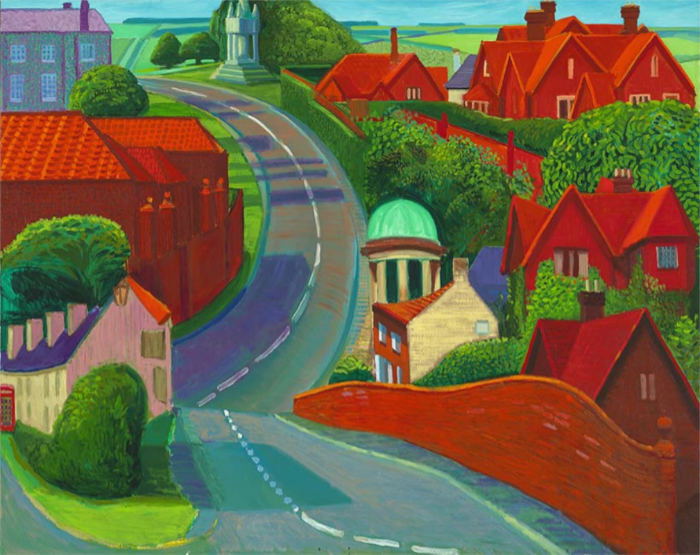
In 1997 Hockney returned to Bridlington, Yorkshire to care for his ageing mother Laura. His friend Jonathan Silver was also dying from cancer. Hockney’s many trips to see Jonathan at his home in Wetherby, Yorkshire took him across the landscapes of the East Yorkshire Wolds, the rolling fields, winding lanes, shifting skies reawakened his love of nature. He returned to Los Angeles in 1998 and painted many of the Yorkshire landscapes from memory. He also visited the Grand Canyon and recreated his experiences in monumental paintings.
In 2000 he used his lifelong fascination with the interplay between photography and painting to begin research into the optical devices used by the old masters. In the 2001 television programme Secret Knowledge, he claimed that the famous Old Masters of the Renaissance and Baroque used camera obscura techniques to project an image of the subject onto the surface of the painting, giving the painter the simple task of filling in the outline with colour. According to Hockney, this technique explained how these artists were able to achieve the photographic quality of their portraits. His view was strongly opposed in several articles, which pointed out the experiences of living artists not using such devices yet still producing paintings of photo-realistic quality.
In 2002 Hockney visited Norway and embarked on a series of watercolour paintings which were later shown in London in 2003.
2005 saw him continue his practice of painting outdoors in the east Yorkshire countryside. He particularly liked experiencing all the seasons and painting in all weathers. Quite a contrast with his home in Malibu where he said the sun always shone.
Major Exhibitions
In 2006, the National Portrait Gallery in London staged a major display of Hockney’s portrait paintings, including self-portraits, comprising over 150 paintings, drawings, prints, sketchbooks and photo-collages completed over the previous 40 years. It was a great success.
The Royal Academy Summer Show the following year, he displayed the largest painting he ever created ‘Bigger Trees Near Warter’ a monumental-scale view of a coppice in Yorkshire measuring a massive 15 feet by 40-feet. It was painted en plein air on 50 individual canvases, over a period of 5 weeks. After the show the work was donated by Hockney to the Tate Gallery in London. It is probably the largest plein air painting ever created and demonstrated his mastery of scale and colour.
His Yorkshire landscapes culminated in the Royal Academy’s A Bigger Picture exhibition in 2012, a blockbuster show that attracted record crowds. Despite the fact Hockney was 75 years old he refused the idea the exhibition should be called a retrospective. Also, that year he was awarded the Order of Merit, the most prestigious honour for achievements in the arts and held by only 24 living recipients. He did accept the award despite having turned down a knighthood in 1990.
Hockney Falls in Love with the iPad
Never one to rest on past achievements, Hockney embraced digital technology with enthusiasm. In 2010 he began drawing on an iPad, producing luminous images of flowers, interiors and landscapes. He enjoyed the immediacy of the medium, often emailing drawings to friends before breakfast.
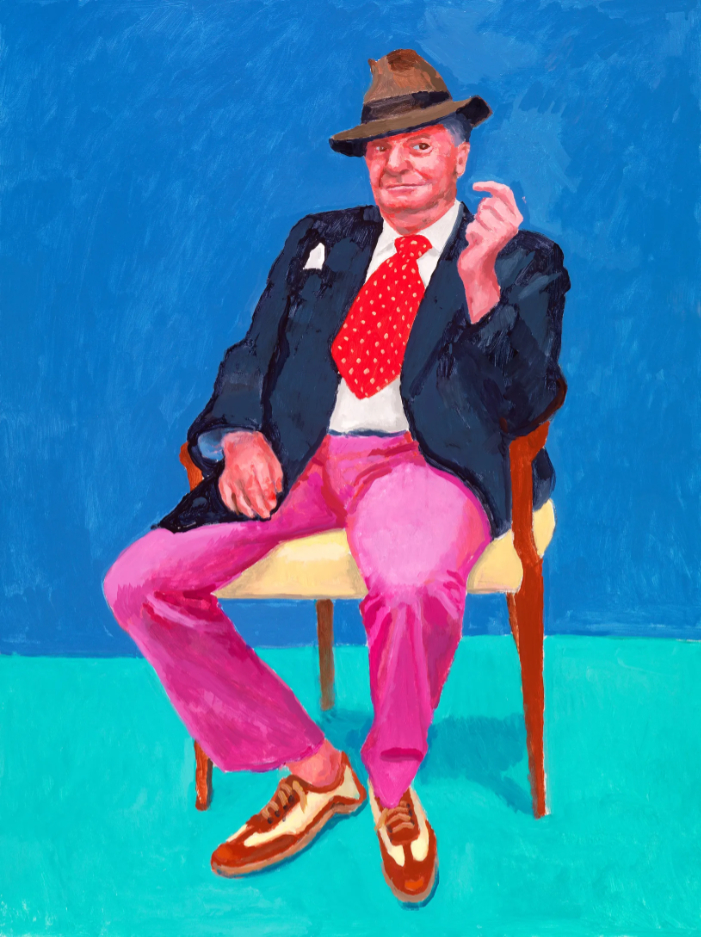
In July of 2016 the 82 Portraits and 1 Still Life exhibition opened at the Royal Academy of Arts in London. The 82 sitters are all seated on the same chair and painted against the same simple background. The one still life comprised a bright blue bench on which sat fruit and vegetables. It was included in the exhibition because it was painted when one of his sitters cancelled at the last minute.
In October 2018 Hockney attended the opening of the Queen’s Window at Westminster Abbey. Designed by Hockney and more than 20 feet high, the window replaced one of the last clear glass windows left in the 11th century building.
In 2020 the National Portrait Gallery in London put on a show entitled David Hockney: Drawing from Life. It covered his whole career from the early collages and coloured pencils drawings of the 60’s to his more recent charcoal drawings and iPad drawings done at his home in Normandy.
Hockney’s Connection with Normandy
During the COVID 19 pandemic, Hockney worked in Normandy, creating a series of iPad paintings celebrating the arrival of spring. These works radiated optimism at a time of global uncertainty, with Hockney insisting that “spring cannot be cancelled.”
The highlight of 2023 saw the Bigger & Closer (not smaller & further away) show open at the Lightroom in London’s King’s Cross. It was an immersive digital installation that wrapped viewers in animated projections of a personal journey through sixty years of Hockney’s work.
2024 saw the exhibition David Hockney, Normandism open at the Musee des Beaux-Arts in Rouen as part of the Festival Normandie Impressionist marking the 150th Anniversary of Impressionism. Hockney showed works created on his iPad during 2020 when he spent a year in Normandy.
In 2026 Hockney was awarded Officer in France’s Legion d’Honneur and on the 12th of March of that year the Serpentine gallery in London began showing Hockney’s most recent paintings alongside his panoramic iPad frieze, A year in Normandie. The exhibition aimed to link his observations of seasonal change in Normandy with his current studio work.
David Hockney’s Legacy
But later that year on 11 June, 2026 David Hockney passed away at his home in London. He was 88 years old. In strict accordance with his final wishes, his private funeral was attended by only two mourners: his partner, Jean-Pierre Gonçalves de Lima, and his great-nephew, Richard Hockney. He declined an offer to be buried in Westminster Abbey alongside the historical greats of British society, choosing instead to rest in Yorkshire alongside his family.
David Hockney’s influence on contemporary art is immense. He has challenged traditional notions of perspective, embraced new technologies, and demonstrated that joy and beauty remain powerful artistic forces. His work bridges generations, appealing to both seasoned art historians and young audiences who experience his work on social media.
Hockney’s legacy is not merely visual but philosophical. He has consistently argued that looking — really looking — is an act of love. His art invites viewers to slow down, observe carefully and find delight in the everyday.

David Hockney’s Artwork
Leave A Comment