
Art History School
Learn Art History Online Through Free Videos, Lessons & Artist Stories

Why Learn Art History?
Studying art history helps us understand the people, ideas and events that have shaped our world through creativity. By exploring the lives of great artists, the stories behind famous paintings and the development of art movements, we gain a deeper appreciation of culture, history and visual communication.
At Art History School, you’ll find engaging videos, fascinating articles and easy-to-follow resources that make learning art history enjoyable, accessible and inspiring for students, teachers, artists and anyone with a passion for art. Whether you’re studying for a course or simply exploring for pleasure, our expert content brings the history of art to life.

Step into the powerful and unsettling world of Paula Rego, one of the most important figurative artists of the late 20th and early 21st centuries.
Want to explore another powerful British artist? Check out Lucian Freud
What You Will Learn
- Explore the lives of famous artists – Van Gogh, Picasso, Monet etc
- Discover Art Movements – Cubism, Surrealism, Pop Art etc
- How to Analyse Paintings and Appreciate Art
- Wonder at some amazing Art Stories
Why This Site Exists
Art History education is an important element in any culture. Here you’ll discover fun and interesting ways to enhance your online art learning.
I hope you enjoy my jargon reduced art history teaching.
Paul Priestley – artist educator with over 30 years teaching experience
Start your Art History Journey Here
Learn How to Appreciate Art?
Not sure where to start? Ever wondered why that painting is in a gallery? How do you ‘read’ a painting? Symbols, abstraction, composition, impasto what does it all mean?
Learn how to analyse paintings and much more with our FREE ‘How to appreciate Art’ guide, you’ll soon be an expert. Start NOW.
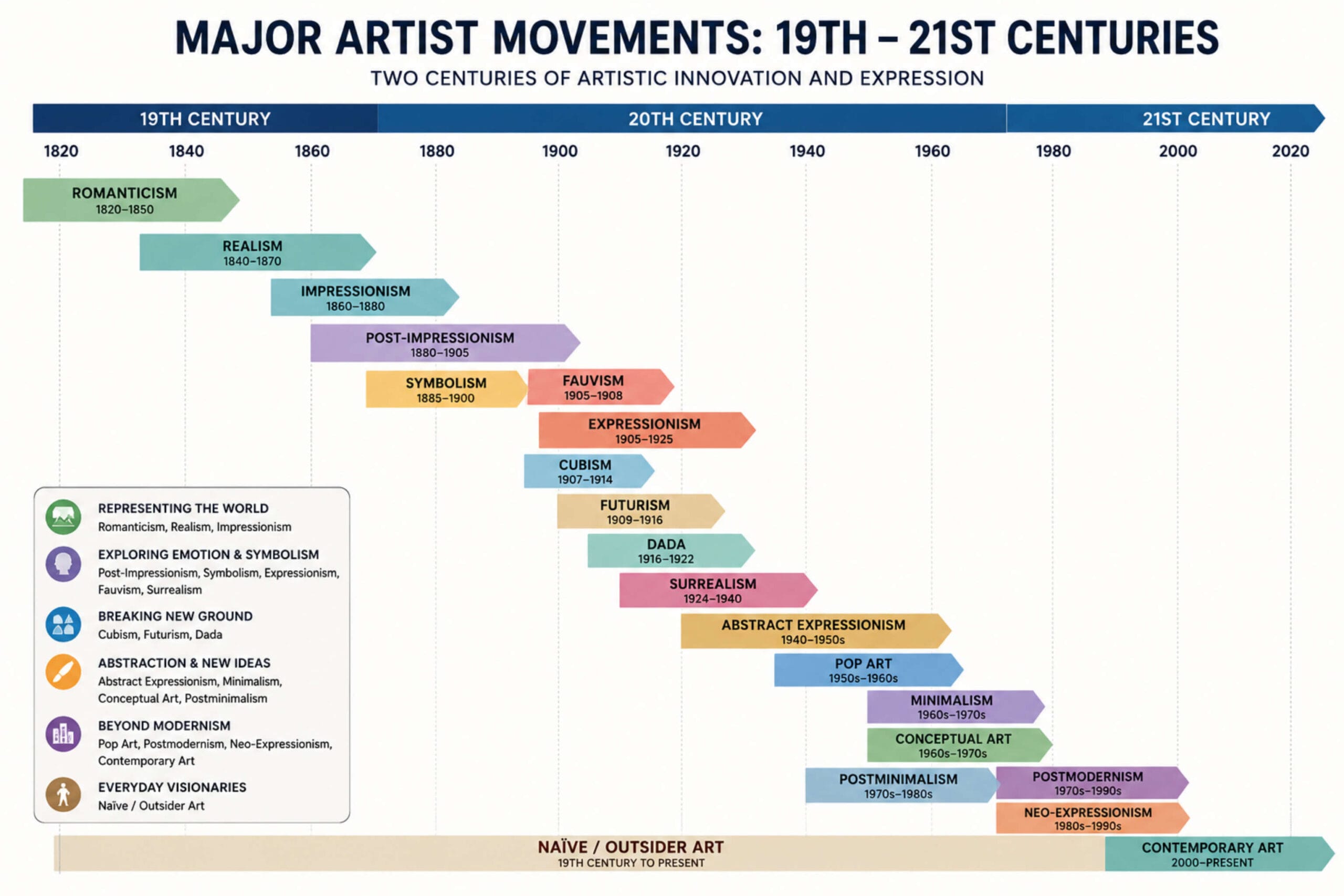
Learn about the Movements in art – a Simple Guide
From around 1850 to the present day
Late 19th Century: Breaking from Tradition
- Realism (1850–1900)
- A direct rejection of Romanticism. Artists like Gustave Courbet began depicting every day, unembellished life and working-class people with truthful accuracy.
- Naïve Art (1860s–Present)
- Known for its childlike simplicity, vivid colour and preferring instinct and directness over perspective or proportion. Artists such as Henri Rousseau, and later L S Lowry, were great exponents of the genre.
- Impressionism (1860s–1880s)
- Pioneered by Claude Monet and Edgar Degas, this movement abandoned academic finishes in favour of visible brushstrokes, vivid colours, and capturing the fleeting, subjective “impression” of light and time.
- Post-Impressionism (1880s–1905)
- Artists like Vincent van Gogh and Paul Cézanne expanded on Impressionism but pushed further into emotional expression, bold colour theory, and geometric structure.
Early to Mid-20th Century: The Rise of Modernism
- Fauvism (1905–1908)
- Led by artists such as Henri Matisse and André Derain, the Fauves transformed landscapes and figures using bold, non-naturalistic colour and loose brushwork with an emphasis on emotional expression.
- Cubism (1907–1914)
- Led by Pablo Picasso and Georges Braque, Cubism revolutionized visual art by deconstructing subjects and analysing them from multiple, fragmented viewpoints simultaneously.
- Surrealism (1920s–1950s)
- Drawing heavily on psychoanalysis, Surrealism sought to unleash the creative potential of the unconscious mind. Salvador Dalí and René Magritte used dream-like, bizarre imagery to challenge reality
- Abstract Expressionism (1940s–1950s)
- Centred in New York, artists like Jackson Pollock (Action Painting) and Mark Rothko (Colour Field) abandoned recognizable subjects to prioritize spontaneous, subconscious emotional expression.
Post-War to Late 20th Century: Challenging the Establishment
- Pop Art (1950s–1960s)
- A vibrant, consumer-driven reaction against elitist “high art.” Andy Warhol and Roy Lichtenstein utilized mass-media, comic strips, and advertising imagery.
- Minimalism (1960s–1970s)
- Stripping art to its absolute essentials. Painters like Frank Stella focused on pure, geometric shapes, raw materials, and literal presence rather than symbolic meaning.
- Conceptual Art (1960s–Present)
- Moving away from the physical aesthetic object entirely, conceptual artists like Sol LeWitt and Joseph Kosuth argued that the idea or concept behind the art is more important than the finished product.
The Contemporary Era
- Postmodernism (1970s–1990s)
- A sceptical response to Modernism that embraced irony, pastiche, and a blend of “high” and “low” culture. Artists like Damien Hirst and Tracy Emin are prominent examples.
- Global Contemporary Art (2000s–Present)
- Today’s art landscape is highly diverse, decentralized, and socially engaged. It frequently tackles themes like globalization, identity politics, and climate change, with creators increasingly utilizing interactive digital platforms to display and distribute their work.
“Art should comfort the disturbed and disturb the comfortable.”
Banksy
