
Paula Rego Biography
Born – 26 January 1935 – Lisbon, Portugal
Died – 8 June 2022 – London, England

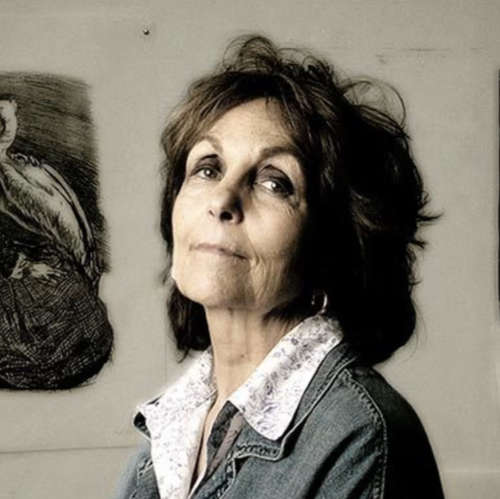
Paula Rego
Biography
- Born – 26 January 1935 – Lisbon, Portugal
- Died – 8 June 2022 – London, England
Paul Rego Feminist Art Icon
Paula Rego was one of Britain’s most celebrated contemporary artists, renowned for her powerful figurative paintings and prints that explore folklore, family, politics and the complexities of human relationships. Her vivid storytelling, psychological depth and unforgettable characters have secured her place as one of the most influential artists of the twentieth and twenty-first centuries.
Some of the questions answered in this biography
- What was Paula Rego’s influence on contemporary art
- Why was Paula Rego’s Dog Woman series so important?
- Why was Paula Rego’s Abortion Series so shocking?
- What was the storytelling in Paula Rego’s paintings based on?
Paula Rego’s Early Life
Paula Rego was born on 26 January 1935, in Lisbon, Portugal into a middle-class family during the period of Estado Novo, the authoritarian New State, established under the fascist rule of António de Oliveira Salazar. Rego’s childhood was marked by Salazar’s increasingly repressive autocracy which included draconian censorship laws, a powerful secret police, and the inhumane imprisonment of any dissidents.
Her father José was an electrical engineer who worked for the British Marconi Company and was ardently anti-fascist. He was a liberal and a very kind man who encouraged his daughter’s independence and her art. Her mother Maria was a schoolteacher and a competent artist but a rather conventional individual. Although she encouraged Rego’s interest in drawing from a young age, she hoped she would pursue a more conventional profession, like law or medicine.
In 1936 her father was promoted to a new position in Marconi’s and had to move to the United Kingdom. Rego’s parents left their daughter behind in Portugal in the care of her grandmother who became a significant figure in her life. It was from her grandmother and the family maid that Rego learnt many of the traditional Portuguese folktales that would later greatly influence her painting.
Keen Anglophiles
Rego’s family were keen Anglophiles, so she was sent to the only English-language school in the Lisbon area at the time, Saint Julian’s School in Carcavelos. It was British International Anglican school. She attended the school from 1945 to 1951. The school was chosen because her father was hostile to the Roman Catholic Church, but the decision created some confusion in the young Rego, because her friends were catholic and Portugal was a devoutly Roman Catholic country. Rego later described herself as being a “sort of Catholic”.
But even at this early age Rego’s sense of right and wrong strongly influenced her art which sought to expose and challenged the abusive regime of the dictator Salazar. She fearlessly maintained this anger against injustice in her work throughout her life. As we shall see later with works that rage against the mistreatment of women and girls, colonialism, the war in Iraq, human trafficking, and authoritarianism, to mention but a few.
Paula Rego’s Move to England
In 1951, Rego was sent to the United Kingdom to attend the finishing school called The Grove School, in Sevenoaks, Kent. Its primary aim was individual coaching in social graces, languages, domestic arts and vocational guidance. But Rego hated the place and in 1952 attempted to enrol at the Chelsea School of Art in London. But her legal guardian, David Phillips, advised her parents, who were back in Portugal, against this choice because he had heard that a young woman had become pregnant while a student there. He suggested the Slade School of Fine Art in London would be a more respectable choice and he was instrumental in helping her achieve a place there.
Paula Rego attends the Slade School of Art
So, in the autumn of 1952, with help from David Philips, Rego enrolled at the prestigious Slade School of Fine Art. Where she was lucky enough to study under Sir William Coldstream and Victor Pasmore. During her time at the Slade, she was fascinated by the modernist movements of the time, especially the work of surrealists, and in particular the work of Salvador Dalí and Max Ernst. But she was also captivated by the works of the Old Masters, such as Francisco Goya, Élisabeth Le Brun, and Edgar Degas. These diverse artistic traditions proved a vital inspiration for her later work, which seamlessly integrated elements of realism with dreamlike and distorted imagery.
Interesting, while at the Slade Rego later mentioned that the only tutor she got on really well with was LS Lowry. He was a visiting tutor who, she said, ‘was wonderful to me, so kind he was always a friend, and he understood, he just understood.’
The Affair with Victor Willing
During her time at the Slade Rego embarked on an affair with fellow student Victor Willing, who was married to the artist, Hazel Whittington. The affair would eventually become a long-term relationship, but when Rego was 18 years old she became pregnant But Willing threatened to return to his wife if she kept their child. So, she had a termination.
Rego completed her studies at the Slade in 1956, and in 1957 she left the UK to return to Portugal to live in Ericecia, primarily because she was pregnant again and had decided to keep the baby. After the birth Victor Willing joined her Portugal. He divorced Hazel Whittington in 1959 and married Paul Rego later that year. But the political climate in Portugal under Salazar’s regime remained oppressive and Rego found it increasingly difficult to gain recognition and to show her work.
Paula Rego Lives in London
In 1962, Rego’s father bought the couple a house in London, in Albert Street in Camden Town, and for the next few years Rego’s time was spent divided between England and Portugal.
Rego’s personal life, particularly her relationship with her husband, Victor Willing, played a key role in her development as an artist, he was also a talented painter in his own right. As a couple they soon became an integral part of London’s artistic community and Rego’s involvement with the London Group of which David Hockney and Frank Auerbach were members opened doors for her and as a result she soon took part in exhibitions of the London group.
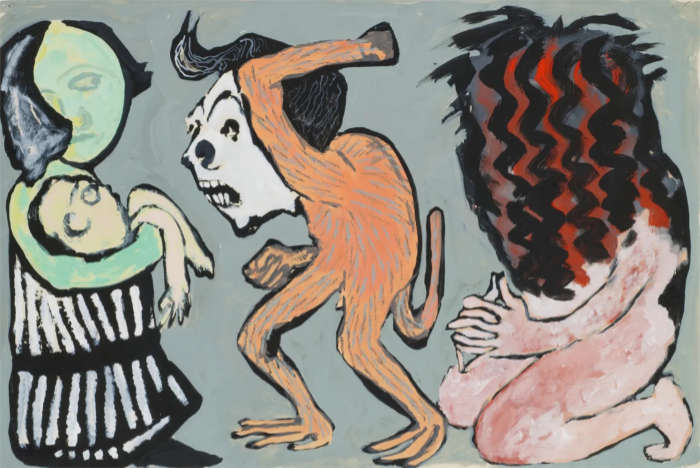
Her earliest major works such as ‘Salazar Vomiting the Homeland’, painted in 1960 and ‘Always at Your Excellency’s Service’, painted in 1961 were strongly influenced by Surrealism, and particularly the work of Joan Miró. This is apparent in the type of imagery she uses and in the use of the Surrealist method of automatic drawing. Automatic Drawing was a method whereby the artist would try to disengage their conscious mind from the drawing process, so the unconscious mind could direct the image making. Although her paintings at this time verge on the abstract there is still a strong narrative in place.
Paula Rego’s Turbulent family Life
Rego and Willing would eventually have three children together and it’s her experiences as a mother and her relationship with Willing that is often the source for her paintings deep psychological content and autobiographical undertones. Her relationship with her husband was difficult at times, he had several extra-marital affairs and some of his mistresses were later depicted in Rego’s drawings in tense, uneasy postures as she explored themes of trauma, repression, and desire.
In 1966, Rego’s father died, and the family electrical business was taken over by Rego’s husband, Victor Willing. Rego’s father, before he died, had advised that the business be sold after his death, because he was concerned about Willing’s heavy drinking. But his wishes were ignored and Willing took over the business despite having no idea how to run a business or any experience of electrical engineering. He also spoke little Portuguese. The company failed in 1974 when its production works were taken over by revolutionary forces during the Carnation Revolution that overthrew the country’s right-wing dictatorship. This was despite the fact that the Rego family had always been supporters of the political Left. Around this time Willing was diagnosed with multiple sclerosis. Times were very hard. So, in 1976 the Rego’s had no choice but to move permanently to London. This period found Rego at her lowest ebb, Willing’s multiple Sclerosis was advancing, and they were virtually penniless.
Paula Rego’s Work Evolves
Rego’s career began to evolve in the 1980s as she began to delve into more personal and deeply emotive subject matter. During this period, she shifted her focus to the exploration of gender, power dynamics, and the representation of women’s experiences. She became increasingly interested in creating works that depicted the inner lives of women, often addressing their sexuality, their social roles, and their psychological states.
In the early 1980’s during the darkest days of caring for her husband who was in his final years, she embarked on a series of works featuring girls and dogs. She poured, into these works all the complexities of being a carer: loyalty, obligation, tenderness and resentment. Several years after Willing’s death in the 1990’s, her “Dog Women” series would take these ideas further. I’ll talk about those paintings later.
Lila Nunes
In 1985 Rego engaged an au pair, Lila Nunes from Portugal to look after her now infirm husband. Lila Nunes and Paula Rego became great friends partly because Rego had a gift for making people feel at ease and was a good listener. In a later interview Rego said, ‘Lila looked after my husband when he was dying. She used to help him paint. Then she took up nursing. She would sit for me in her spare time. She still does. She knows exactly what to do, she can read my mind. She knows what I want, and she does it. She just takes a position, and I go with it, it grows from there. She’s terribly important to my work. I like having her there with me.’ Many of Rego’s paintings from this point onwards feature Lila Nunes.
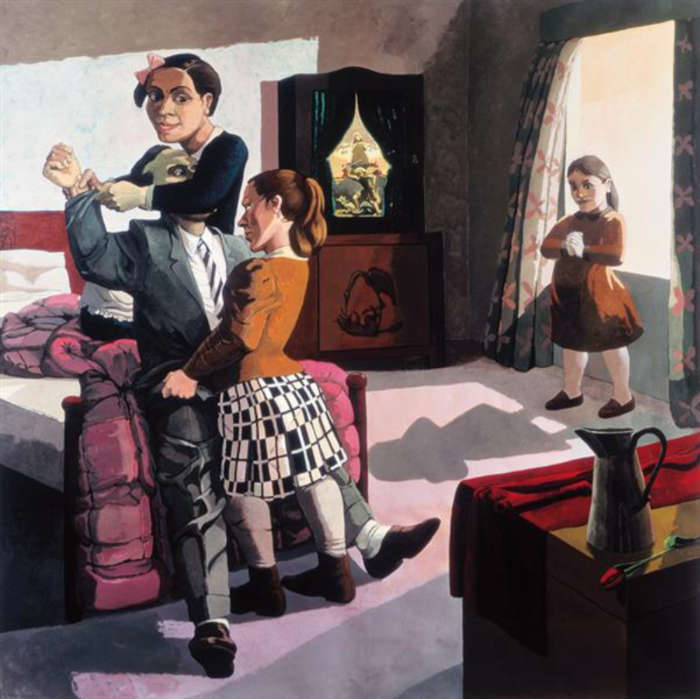
In 1988 she produced the painting ‘The Dance’ which was part of a number of paintings completed during the 1980’s that were inspired by her early life in Portugal. The painting could be seen to represent a memory of folk festivals or ‘festas’ but also has a more profound symbolic meaning. The dance can be read as a dance of life, representing the stages from a girl’s childhood to old age something Edvard Munch had also explored. The painting has an eerie, dream-like quality which is typical of her work, that often refers to childhood fears and fantasy. The work could also be seen as a memorial to Rego’s husband, the artist Victor Willing, who died during its completion.
In 1989 she created her “Nursery Rhymes” series, a series of unsettling and darkly imaginative etchings and aquatints based on traditional English children’s songs. Combining British and Portuguese influences she explored childhood experiences and themes of vulnerability, power, and the darker sides of fairy tales and myths. Many of the figures in the images appear in positions of discomfort or tension, reflecting the complexities of childhood and growing up.
The Dog Woman Series
In 1994 Rego began her iconic “Dog Woman” series which explored women’s strengths and vulnerabilities by creating unsettling, but compelling, visual narratives that draw attention to complex issues like gender and identity. The paintings are often emotionally complicated, depictions of women in tumultuous relationships, blending themes of violence, intimacy, and domesticity.
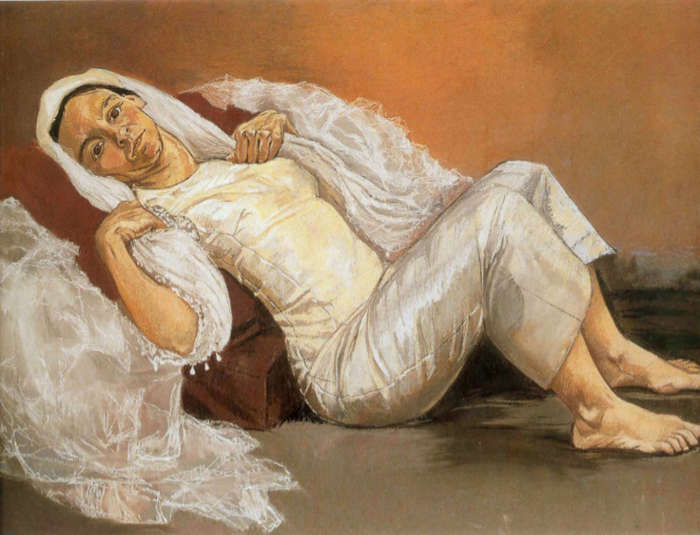
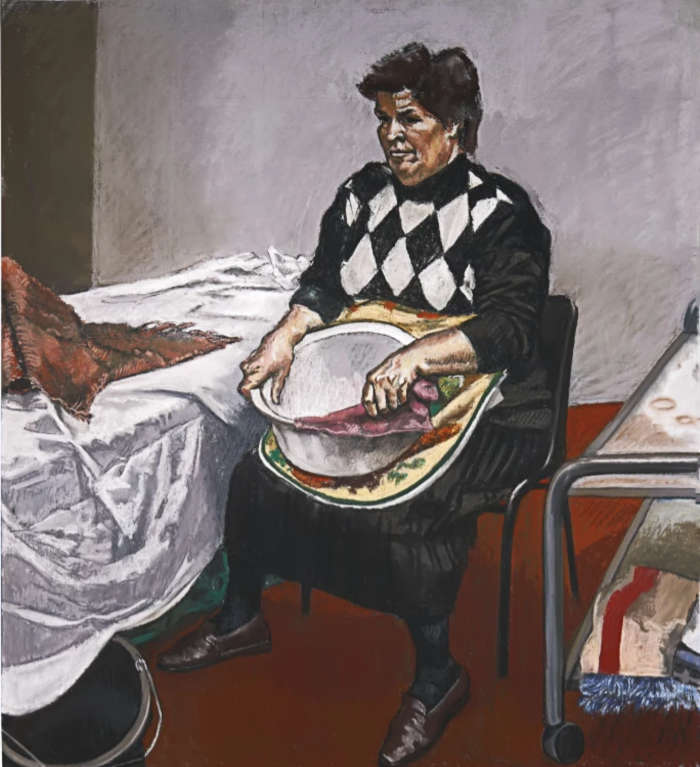
In 1998 a referendum to legalise abortion in Portugal failed. Rego response was to produce 10 large pastel paintings, her tender and unflinching Abortion paintings. This series, which included a series of lithographs, was inspired by her own feelings about the politics of abortion in Portugal and the restrictive laws surrounding women’s reproductive rights. The works in the series were graphic and confrontational, and became part of a larger, politically charged conversation about women’s autonomy. She said later that the paintings ‘highlight the fear and pain and danger of illegal abortion, which is what desperate women have always resorted to. Making abortion illegal is forcing women to the backstreet solution.’ The paintings were later shown at the Calouste Gulbenkian Foundation in her native Lisbon. In 2007, images from the series of etchings based on the paintings were published in Portuguese newspapers in the run-up to the second referendum. Many believed their profound impact swayed the result in favour of legalisation.
Paula Rego Receives Awards
In 2001, Rego was elected a Royal Academician, of the Royal Academy of Art in London and in 2004 she was appointed a Commander of the Order of St. James of the Sword by the President of Portugal in recognition of her contributions to the arts.
In 2005 she created a triptych called The Fisherman. This was one of her compositions that were quite literally was ‘made’ before being drawn and then painted. She made the octopus which was fashioned from wire and stitched and quilted the right-hand image of the fisherman. Rego’s studio was often a heady mix of roughshod papier mâché figures, furniture, fabrics, ornaments, dolls and other miscellaneous objects, which were carefully assembled to enable the real-life models to pose among them. Rego’s live models, most notably her alter ego, muse and close companion Lila Nunes were selected for their willingness to transform into whatever the work demanded of them.
In 2009 the National Gallery in London hosted a major retrospective of her work, which cemented her reputation as one of Europe’s most important contemporary artists. Her works can now be seen in many important collections in the USA, Portugal and the United Kingdom.
Final Years
In 2010, she was made a Dame of the British Empire for services to the Arts in the Queen’s Birthday Honours. Interestingly she was also a lifelong supporter of S.L.Benfica the football club of which her grandfather had been a founding member.
In March 2017, Rego was the subject of a major BBC Arts documentary Paula Rego, Secrets & Stories, which was directed by her son Nick Willing.
Paula Rego died after a short illness on 8 June 2022 at the age of 87 and was buried alongside Victor Willing in Hampstead Cemetery in London.
In Rego’s work we often see the women or girls in the paintings looking directly at the viewer or away in agony or closing their eyes in pain. By doing this she challenged the viewer by depicting the reality of women as human beings in the physical world, rather than an idealised female stereotype. Paula Rego was an astute observer of power play of all kinds, and of all kinds of injustice, particularly against women.

Artwork
Leave A Comment