
Fernand Léger
Born – 4 February 1881 – Argentan, France
Died – 17 August 1955 – Gif-sur-Yvette, France

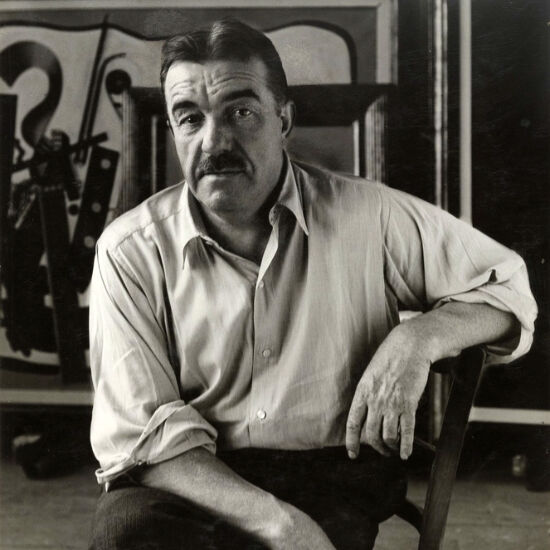
Fernand Léger Biography
Born – 4 February 1881 – Argentan, France
Died – 17 August 1955 – Gif-sur-Yvette, France
Fernand Léger Industrial Cubist Vision
Fernand Léger was a French modernist artist known for his bold, tubular forms and vibrant colours, often associated with Cubism but developing a distinctive mechanical style of his own. His work celebrated modern industry and urban life, blending abstraction with recognizable subjects in a way that made art feel dynamic and accessible.
Some of the questions answered in this Biography
- Where was Fernand Leger born?
- What is Tubism
- Why did he live in the USA
- Was he considered a forerunner of Pop Art
- What are Leger’s most famous paintings
Fernand Léger’s Early Life
Joseph Fernand Henri Léger was born on 4 February 1881 in Argentan, a small town in the Normandy region of France. His father was a cattle dealer who died when Leger was just 3 years old. His mother, Marie a self-effacing and pious woman came from a farming background.
Léger showed an early interest in drawing, though this was not initially encouraged by his family. He was not an academic student, and later admitted he was only interested in drawing and gymnastics at school. Nevertheless, after completing his basic education, he worked as an architectural apprentice in Caen from 1897 to 1899. This training proved significant, as it instilled in him a strong sense of structure, proportion, and spatial organisation.
In 1900, Léger moved to Paris, at that time the epicentre of the European art world. Initially, he found employment as a draughtsman and photographic retoucher. But in 1903 he failed the entrance examination at the Ecole des Beaux Arts, undeterred he attended the Académie Julian for a few months. Not long after he took classes unofficially as a non-enrolled student at the École des Beaux-Arts where he studied under Jean-Léon Gérôme, a prominent academic painter. He studied there for 3 years but found the rigid emphasis on classical technique restrictive. He later described his time there as “three empty and useless years”. In 1906 and 1907 he visited Corsica and was captivated by the Mediterranean light. As a result, he painted a number of Impressionist landscapes, five of which shown in October of 1907 at the Salon d’Automne in Paris.
Fernand Léger’s early Impressionist Paintings
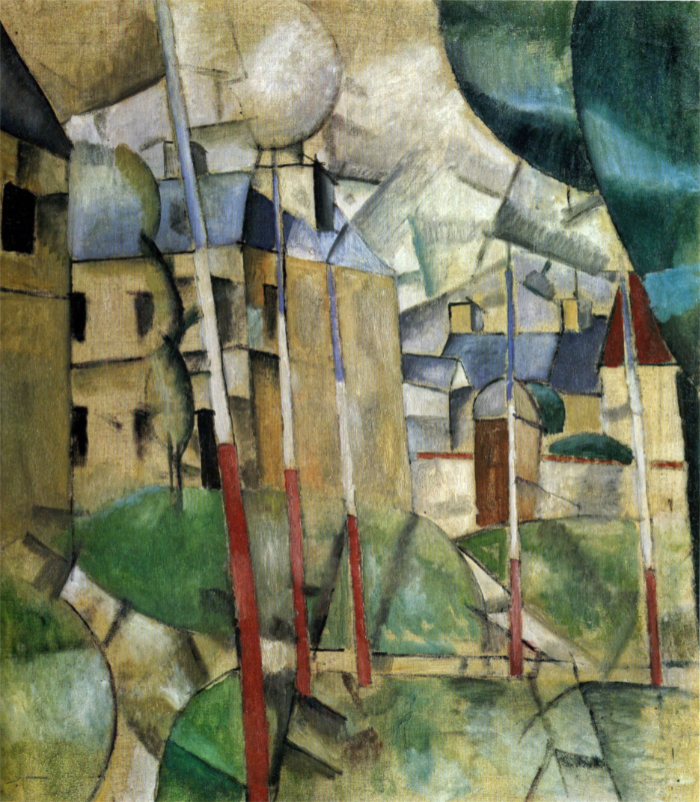
Léger’s early paintings had all been largely Impressionist in style, characterised by soft colours and atmospheric effects. But as he immersed himself in the artistic ferment of Paris, he became influenced by the work of Paul Cézanne, whose retrospective exhibition at the Salon d’Automne in 1907 had a profound impact on him. Cézanne’s emphasis on structure and the reduction of natural forms to geometric elements resonated deeply with Léger’s architectural sensibilities.
Few of these early Impressionist works now exist as Leger destroyed most of his work in 1909. This event together with the Cezanne exhibition marked a symbolic break with his earlier style and coincided with a decisive turn towards a more modern, structured approach to painting.
Move to Paris
In 1908 he moved to La Ruche an artist’s residence in the Montparnasse district of Paris. Here he met Chagall, Delaunay, and Modigliani amongst other artists. One of his most significant early works of this period was, Nudes in the Forest (1909–10). The painting reduces the human body and natural environment to rhythmic, tubular forms, creating a powerful sense of movement and structure. It can be clearly seen that Léger was concentrating more on emphasising the solidity and dynamism of form, rather than depicting multiple viewpoints.
Tubism is Invented
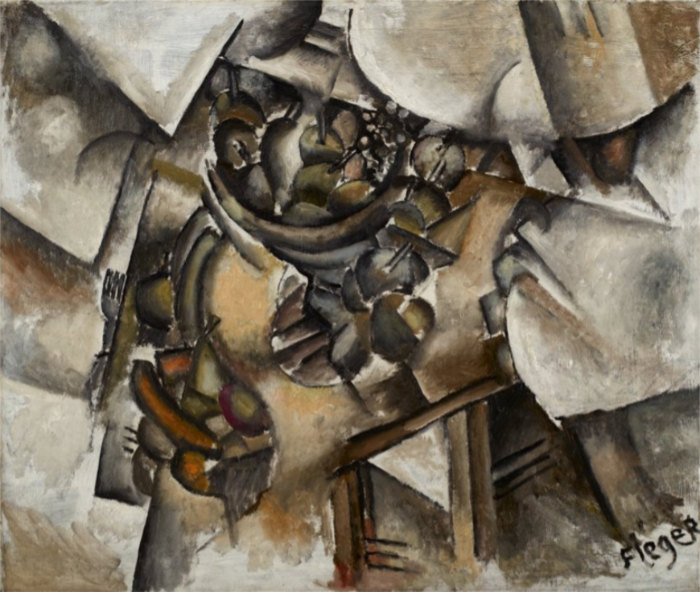
From 1908 onwards Léger’s style developed becoming almost Cubist, but quite distinct from the Cubism of Pablo Picasso and Georges Braque. While Picasso and Braque favoured a muted palette with multiple viewpoints and fragmented forms. Léger chose a different route. He embraced vibrant colours and bold, volumetric forms that were reminiscent of the industrial world. His work often did not depict a clear subject matter, as many Cubist paintings did. In fact, his interpretation of Cubism was so unique that many felt it needed a different name and it was the art critic Louis Vauxcelles who coined the term “Tubism”.
As Léger became part of the circle of avant-garde artists that were based in Montparnasse. He began to associate with such luminaries as Robert and Sonia Delaunay, Guillaume Apollinaire, and later Picasso himself. By 1910 he had established himself as a major figure in the Cubist movement with his work being shown at the Salon d’Automne and the Salon des Indépendants.
Léger incorporates Industrialisation into his work
By 1913, Léger had begun to incorporate explicit references to modern technology and urban life into his paintings. Works such as The City of 1919, (the painting had been conceived much earlier) reflected his fascination with the visual impact of billboards, machinery, and industrial architecture. Unlike many artists who viewed industrialisation with ambivalence or hostility, Léger saw it as a source of aesthetic vitality.
The outbreak of the First World War marked a major turning point in Léger’s life and art. He was conscripted into the French army in August 1914 and served as a sapper on the front lines in the Argonne Forest. While living in the trenches, he sketched the world around him, witnessing the soldiers, weapons, and machinery at close quarters. This served to intensify his interest in mechanical forms.
Léger is seriously injured
In September 1916, Léger was seriously injured by a mustard gas attack at Verdun and was hospitalised in the suburbs of Paris. The long months of convalescence that followed proved crucial to his artistic development. In hospital whilst recovering from the burns to his lungs the gas had caused, he painted ‘The Game of Cards’. This is a fascinating work, because rather than depicting the horrors of war directly, Léger focused on the visual power and formal qualities of the machines of war. In the painting the French soldiers are shown disjointed like robots, dehumanised and reminiscent of machine parts playing cards in the cramped, claustrophobic conditions of the trench. It is perhaps an involuntary homage to Cezanne’s ‘Card Players’ but the difference here is the card players are depicted as a fusion of human and machine forms.
After the war, Léger returned to Paris and entered one of the most productive phases of his career. The post-war period saw a radical shift in European art, with many artists searching for clarity, order, and renewal. Léger responded by developing a cleaner, more legible style, often described as “mechanical classicism”. His ‘Tubism’ still influenced his work, and the human body continued to be treated much like a machine. But organic forms began to play an increasing role particularly in his depiction of ordinary people involved in leisure time activities.
Léger Marries in Paris
In 1919, Léger married Jeanne-Augustine Lohy and met Le Corbusier with whom he would remain close friends especially during the early 1920s. Their friendship and collaboration centred on the modernist art movement Purism, which rejected Cubism’s fragmentation by advocating an art that reflected modern industrial life with simplified, pure, machine-like forms and smooth surfaces.
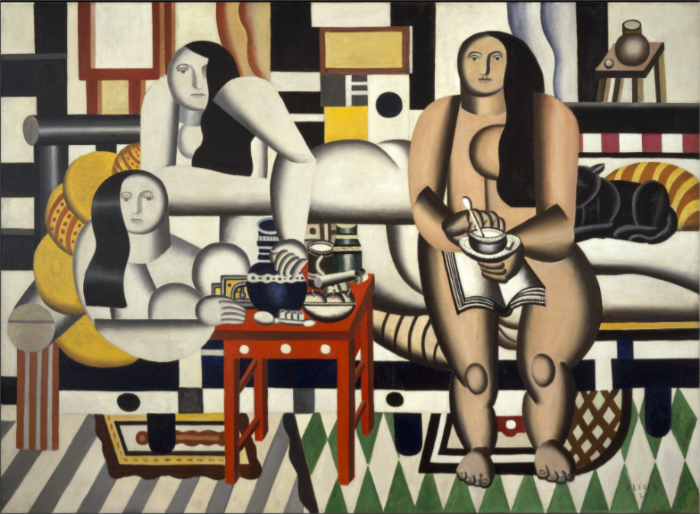
Leger’s clean, figurative style and retreat from abstraction in this period are evident in Three Women of 1921. Also, during this time, he produced a series of paintings featuring isolated objects, human figures, and mechanical elements arranged against flat backgrounds. Works such as The Mechanic (1920) exemplify this approach, presenting the modern worker as a heroic figure integrated with the machine.
Léger works in the theatre and in film
In 1923 Leger designed the curtains, costumes and sets for the Swedish ballet, ‘The Creation of the World’. and became involved in film and experimental media. In 1924, he collaborated with filmmaker Dudley Murphy and composer George Antheil (Ontay) on the Ballet Mécanique, an avant-garde film that combined abstract imagery, repetitive motion, and rhythmic editing. It is considered to be “the first film without a script” and although controversial at the time, the film is now considered a landmark in experimental cinema.
Also, in 1924 he founded in Paris, with Amedee Ozenfant, the Academy Léger–Ozenfant, later known as the Modern Academy which attracted students from all over Europe and America. During this decade, Léger expanded his creativity into areas such as book illustration and mural design. In November 1925, he had his first solo exhibition outside of France at the Anderson Galleries in New York. It was a great success and later in 1926, his costume designs for various Ballets including the ballet ‘The Creation of the World’ were referenced at the International Exhibition of Theatre Arts.
Experimental Art Works
In 1930 he painted ‘Mona Lisa with Keys’’ which is one of Léger’s most experimental canvases. One of the few in which we can see the influence of Surrealism. The objects depicted have no support but rather float in space as in works by Joan Miro. Léger said of this painting: “One day, after drawing a bunch of keys, I went out into the street and saw in a shop window the portrait of Mona Lisa. No contrast has ever been sharper than between this bunch of keys and Mona Lisa.” He considered this “risky picture” a success and kept it for himself.
The economic and political upheavals of the 1930s had a significant impact on Léger’s life. He became increasingly interested in social themes and aligned himself with left-wing politics. He also began teaching painting to manual workers, as part of his activities as a member of the French Popular Front.
Léger believes easel painting is finished
In 1933 Leger gave a lecture at the Kunst museum in Zurich, entitled, ‘The Wall, The Architect and the Painter’ in which he argued that in ‘today’s highly charged, machinelike and collective society, easel painting was no longer as important as it once was. He reproached architects for not entrusting painters to produce polychrome, decorative works that were needed to bring art down from its lofty status.’
It is around this time that he began to see machines as no longer a source of progress, but rather as a means of enslaving man. This idea coincided with long walks in the forest of Fontainebleau that he took when he needed a break. He would pick up flints, sticks, nuts and holly leaves, which often became the starting point for biomorphic and realistic drawings. This wish to see himself, as well as mankind, reconnect with nature, led to the creation of a number of large paintings that focus on a rather utopian vision of a return to harmony between nature and man.
Léger accepts large commissions
He also undertook large-scale public commissions, including murals and decorative schemes, which allowed his art to reach a wider audience. Léger believed that colour and form could have a direct, uplifting effect on viewers, as he sought to bring art into public spaces rather than confining it to galleries.
During the 1930’s Léger’s reputation grew internationally. He exhibited widely in Europe and the United States and spent time in America, where he was impressed by the scale and energy of modern cities.
Following the outbreak of the Second World War in 1939 life in France became difficult following the German occupation of France in 1940, so he left for the United States. He initially stayed in New York which he called, ‘the greatest spectacle on earth’ and remained in exile in the US for the duration of the war. He taught at Yale University and later at Mills College in California, where he exerted a significant influence on American artists.
Léger moves to the USA
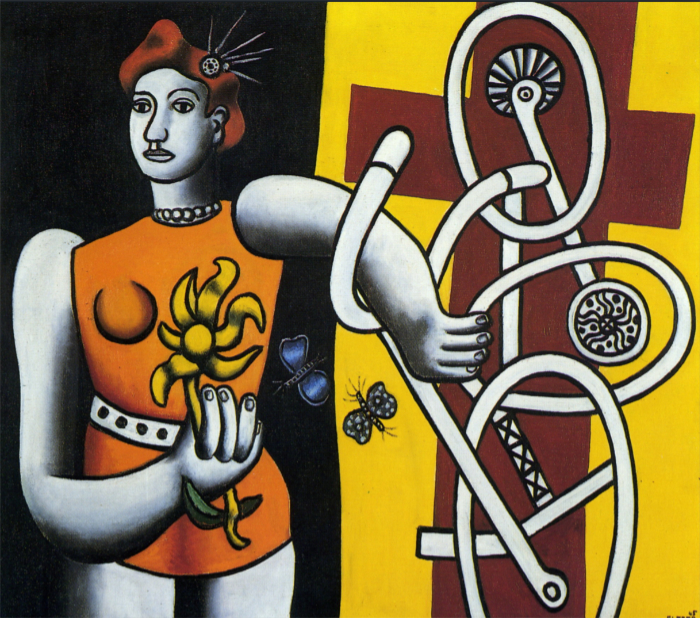
It was in the United States that Léger encountered a new cultural landscape. He was fascinated by advertising, consumer goods, and popular entertainment, elements that reinforced his long-standing interest in mass culture. His work from this period included pictures of acrobats, cyclists, and musicians, and often features bright colours and bold outlines, reflecting both American visual culture and his own evolving style.
Despite the distance from Europe, Léger remained committed to the idea of socially engaged art. He continued to argue that modern art should reflect contemporary life and be accessible to all.
Léger returns to France
After the war, Léger returned to France and late in 1945, he officially joined the French Communist Party, aligning his political beliefs with his long-standing commitment to social equality. In his paintings Léger’s figures became more simplified and monumental, often depicted in leisure activities such as cycling, swimming, or playing cards. Paintings such as Leisure Activities (1931) shows people of different races, ages, and classes united by the shared leisure activity of cycling. Doves and olive branches complement the scene, emphasising Léger’s pacifist ideals. In 1948 he became a founder-member of the National Council of the World Peace Movement. However, Léger’s social conscience was more of a passionate humanist rather than a fierce Marxist.
In 1950 his wife died, they had been married for 31 years. Two years later he married the artist Nadia Khodossevitch who he had known for many years.
Change in style
His later paintings are often characterised by flat areas of intense colour, strong black outlines, and simplified forms. Human figures, often depicted in groups, convey a sense of harmony and collective energy. Works such as Les Constructeurs (1950) exemplify his mature style, portraying construction workers as heroic symbols of post-war reconstruction.
The final decade of his life was marked by extraordinary productivity. Léger worked extensively in ceramics, collaborating with workshops in the south of France to produce colourful plates, tiles, and sculptures. He also completed numerous mural projects, including in 1951 the stained-glass windows and tapestries for the church at Audincourt in Eastern France and in 1954 a glass mosaic for the University of Caracas.
Léger’s final years
Léger continued teaching and writing about art, and its social responsibility until his death. He believed that beauty and joy were essential components of a healthy society and that art could play a vital role in everyday life.
Fernand Léger died on 17 August 1955 in Gif-sur-Yvette, near Paris. He was 74 years old.
In 1960 the Fernand Leger Museum was opened in Biot, near Antibes in Southern France, on the same site where Leger had spent his last years working on mosaics, windows and ceramics. Nadia, his second wife was very much involved in its design.
As a teacher, Léger influenced countless artists on both sides of the Atlantic, promoting an art that was socially engaged, visually powerful, and accessible. As an artist Léger embraced modernity without losing sight of humanity. His belief that art should belong to everyone continues to resonate in contemporary debates about public culture even today.

If you liked Léger, watch
Georges Braque
Artwork
Leave A Comment