
Artist Profile
Lucian Freud
Born – 8 December – Berlin, Germany
Died – 20 July 2011 – London, England

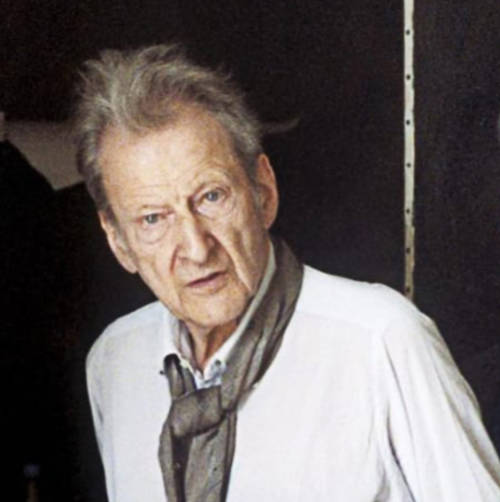
Artist Profile
Lucian Freud
- Born – 8 December – Berlin, Germany
- Died – 20 July 2011 – London, England
Lucian Freud who, as a young émigré in the 1930’s, became one of Britain’s most esteemed artists. Working in a highly detailed, realist style, Freud painted, friends, family, and lovers with a raw honesty, rather than an idealistic vision that would change our perception of portraiture.
Lucian Freud’s Early Life
Lucian Michael Freud was born on 8 December 1922 in Berlin, Germany, into a Jewish family of some distinction. He was the second son of Ernst Ludwig Freud and his wife Lucie Brasch the daughter of a wealthy grain merchant Joseph Brasch. His father, Ernst was an architect, and his mother, Lucie was a writer. His grandfather was Sigmund Freud the founder of psychoanalysis. Lucian was the second of three sons; his younger brother, Clement Freud, became a well-known broadcaster and politician.
The family fled Germany in 1933 when Freud was 10 years old following Adolf Hitler’s accession to the German Chancellorship and the establishment of Nazism. They subsequently settled in the St John’s Wood area of London. Later in life Freud said that moving to England was “Linked to my luck… London, the place I prefer in every way to anywhere I’ve been.”
In 1933 he attended Dartington Hall School in Totnes in Devon. Dartington Hall was a liberal boarding school known for its progressive educational philosophy. Lessons were largely optional which meant Freud spent a lot of time helping with the animals on the school farm. He later moved to Bryanston School in Dorset. There he became a leading member of the Oil Painting Club, which demonstrated his early interest in art. But he was far more interested in horses and riding than schoolwork and was subsequently expelled from the school after a year for disruptive behaviour.
Lucian Freud’s Art Education
Freud began making art – and exhibiting it – at a very early age. In 1938 one of his drawings was selected for a show of art by children at Peggy Guggenheim‘s London gallery. Though Freud was sixteen at the time, the drawing was from 1930, when he was just 8 years old.
In his late teens, Lucian Freud became a friend with the poet Stephen Spender. The two remained in touch for several years, and it is probably through this acquaintance that Freud was introduced to a circle of male, mostly bisexual, poets, artists, and teachers. It is likely it was here that he met his best friend and future rival Francis Bacon.
After school Freud began to pursue a formal art education. He briefly attended the Central School of Art in London but often missed classes because he found the structured environment too restrictive. In 1939 he became a naturalised British citizen and around this time he moved to Dedham in Suffolk and began studying art seriously under Cedric Morris at the East Anglian School of Painting and Drawing. On 7 March 1940, the Evening Standard reported that Freud ‘promises to be a remarkable painter… intelligent and imaginative, with an instinctive rather than a scientific psychological sense’.
Time in the Navy
In March 1941 Freud spent a brief three months in the Merchant Navy on an Atlantic convoy aboard the SS Baltrover. He had hoped to get to New York, but the convoy went to Halifax in Canada. Freud suffered from illness on the voyage and was classified as unsuitable for military service on his return. So, her returned to study at the East Anglian School of Painting and Drawing where he stayed until mid1942 before spending a year studying at Goldsmiths College, in London.
In 1943 Freud gained his first notable commission to illustrate The Glass Tower, a poetry collection by Nicholas Moore. The largely pen and ink drawings for the book included such illustrations as a stuffed zebra, monkeys and crumpled paper.
In 1944 Freud had his first solo exhibition which took place at the Alex Reid and Lefevre Gallery in London. These early works were heavily influenced by Surrealism and often featured distorted figures and dreamlike scenarios with a juxtaposition of plants, animal and figures. The influence of artists such as Salvador Dalí can be clearly seen in his work at the time.
Lucian Freud’s Style Develops
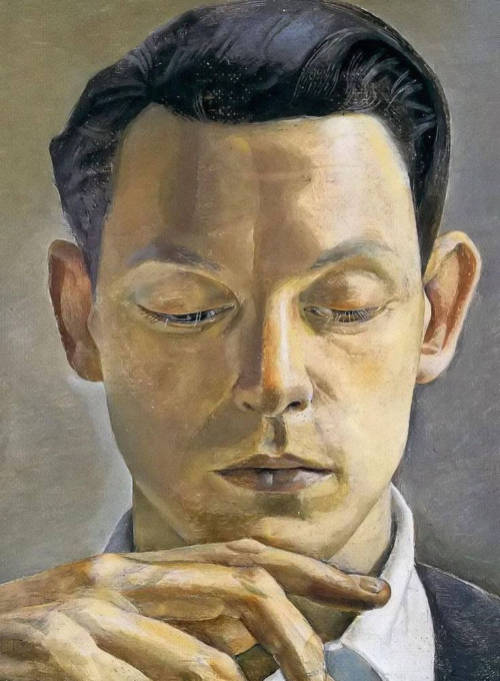
As the 1940’s wore on Freud’s early style became more defined. Paintings such as ‘Man with a Thistle’ of 1946 show precise, fine brushwork, great attention to detail and a muted colour palette. His painting was very expressive and at times displayed a haunting psychological presence. As can be seen in his portraits of his first wife, Kitty Garman. ‘Girl with a Kitten’ of 1947 is a typical example.
Freud spent a brief period in Paris in 1946 where he befriended Pablo Picasso and Alberto Giacometti, who influenced on his work. Later, Freud taught intermittently as a visiting tutor at the Slade School of Fine Art in London between 1948 and 1958, but his focus was on his own work. Freud had a great intensity towards his artwork, which he regarded as more important than everything else. This, together with his habitual infidelity, his love of drinking and betting in the numerous bars and clubs in and around Soho, led to the failure of his many romantic relationships. He was a very charming man but he possessed a volatile temper.
Lucian Freud marries Kitty Garman
In 1948 he married Kitty Garman, the daughter of the sculptor Jacob Epstein and Kathleen Garman and had two daughters: Annabel and Annie who later became a poet. The marriage lasted barely 4 years. His painting “Portrait of Kitty” is one of his notable works from this period. It showcased his emerging realist style and the beginning of his focus on portraiture and the human form and his move away from surrealistic elements. Portraiture would come to dominate his career as he focused on the human form with ever increasing intensity.
In 1950 he had his first solo exhibition at the Hanover Gallery in London. His reputation as a foremost artist was increasing. Later in 1951 he painted ‘Interior at Paddington’, which won an Arts Council prize at the Festival of Britain of that year. The painting depicts Freud’s friend Harry Diamond who appears less important than the room and its contents. Yet he still carries an air of menace and uncertainty which makes the painting intriguing. During this period his figurative work tended to investigate the psychology of internal spaces and the human presence in it.
Despite the birth of his second daughter, Annabel in 1952 Freud’s marriage to Kitty ended shortly afterwards. Resulting in him spending a period in Paris and Dublin before he returned to his old haunts in Soho and his studio in Delamere Terrace, Paddington, London.
Freud Elopes
Late in 1952 Freud eloped with the Guinness heiress Lady Caroline Blackwood, a writer and aristocrat. He married Lady Caroline on 9 December 1953 shortly after his divorce from Kitty. Lady Caroline divorced Freud five years later in 1958, they had no children together, although Freud later in life acknowledged 12 other children by various mistresses.
In 1954 he painted Lady Caroline in ‘Hotel Bedroom’, she also appeared in other portraits during the next couple of years. Also, in 1954 he exhibited at the Venice Biennale representing Britain in a showcase shared with Francis Bacon and Ben Nicholson.
A Change of Technique
In the mid 1950’s his style began to evolve. The very precise, thinly painted works were gradually replaced by thick, textured brushstrokes and a focus on the physicality of the human body. He employed impasto techniques, layering paint to create a tactile surface that emphasized the contours and textures of his subjects’ skin. This approach gave his paintings a sculptural quality, that captured the rawness and vulnerability of the human form. Portraiture became increasingly the focus of his work.
Freud’s approach to figuration was obsessive, attempting to capture every detail and flaw of an individual. He preferred to work from life, observing his subjects closely to capture their essence. Which often meant sitters trying to hold poses for very long periods. This meticulous process resulted in works that conveyed a deep psychological insight into his sitters but often led to the frustration of the sitter and Freud himself.
To lessen the frustration, he began experimenting. One key technical breakthrough which came around this time was when he switched to using stiffer hog-hair brushes. These allowed him to apply paint more broadly. His decision to stand rather than sit while he worked also had a big impact. Freud’s portraits were often painted over extended periods, sometimes taking months to complete.
Freud’s Life outside of Painting
The few hours a day when he wasn’t painting, he would be found dining, gambling and generally lounging in the company of fashionable British aristocrats, socialites, and artists, including fellow painter and great friend Francis Bacon. The two shared a mutual respect and often discussed art and life. Bacon’s emotive use of the human figure and his exploration of psychological depth had a lasting impact on Freud’s work. The friendship lasted until the mid-1980’s when there was a major falling out between them.
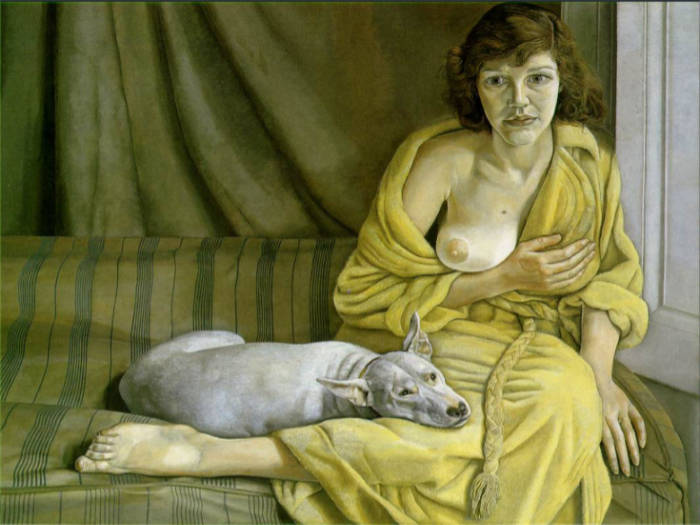
In the 1960’s Freud created his first full length nude painting and began to focus on what he called ‘naked portraits’. These were very closely observed and always unflattering detailed. The portraits were from a very close set of individuals, friends, lovers and a few models. It was in the 1960’s that his work was regularly shown in the Marlborough Gallery in London.
In 1970 Freuds father Ernst died, and it is around this time that Freud started a series of drawings and paintings of his mother, which continued until her death in 1989. The works are intimate studies and often visually confronting. The works display Freuds increasing willingness to explore ageing, mortality and human flesh in decline. These works along with all his portraits were painted very slowly, methodically and involved numerous sittings. When funds were short, he would often approach eminent figures to sit for him. The Duke of Devonshire (‘Portrait of a Man’, 1971-2) and Jacob Rothschild (‘Man in a Chair’, 1989) being amongst the most prominent.
Major Exhibitions
In 1974 he had his first major retrospective in Britain organised by the Arts Council at the Hayward Gallery in London. This went a long way to consolidating his reputation both nationally and internationally. 1977 saw Freud move into a top-floor flat in Holland Park, it was here he painted ‘Large Interior W11’ (after Watteau) between 1981 and 1983.
In 1980 he resumed etching, as this proved to be a handy means of instant money in the time between the sale of paintings and big wins at the bookmakers. During the 1980’s Freud’s reputation grew. During 1983, he was made a Companion of Honour for his services to the Arts. Later between 1987 and 1988 he had a number of international retrospective exhibitions: notably at the Hirshhorn Museum in Washington, D.C which was organized by the British Council. The exhibition subsequently toured the Hayward Gallery in London, the Pompidou Centre in Paris and the National Gallery in Berlin.
Lucian Freud’s Dedication to Portraiture Intensifies
Around this time Freud bought a house on Kensington Church Street, Kensington but he kept his flat in Holland Park.
By the 1990’s Freud’s dedication to portraiture and the nude intensified. He began to depict more unconventional body types, fat bodies, ageing bodies, queer bodies, exhausted bodies. Some critics described his portraits as ruthless, pitiless, clinical and cruel; whilst others saw them as intimate and honest records of humanity. Freud once described himself as “a sort of biologist”, interested in “the insides and undersides of things”.
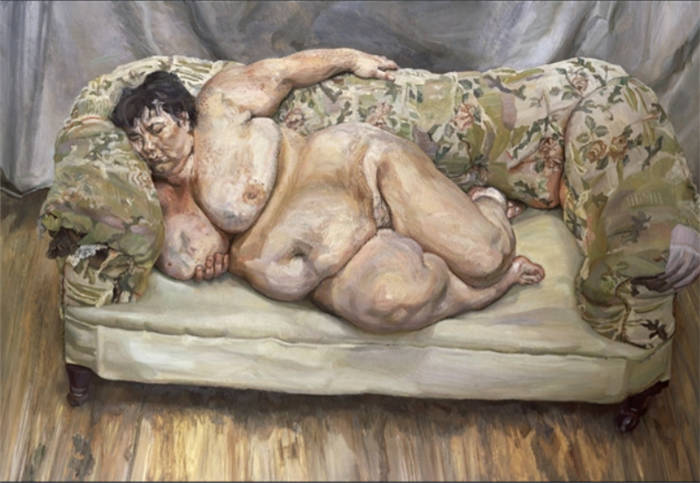
One of his most famous works of this period is “Benefits Supervisor Sleeping” of 1995, which depicts his model Sue Tilley in a reclining pose. The painting received a lot of attention when it was exhibited eventually selling at auction in 2008 for £17.2 million around US$33 million, which at the time, was the highest price ever paid for a work by a living artist.
In 1993, Freud was appointed to the Order of Merit. The Order is conferred on only 24 individuals of exceptional distinction and is given as the Sovereign’s personal gift.
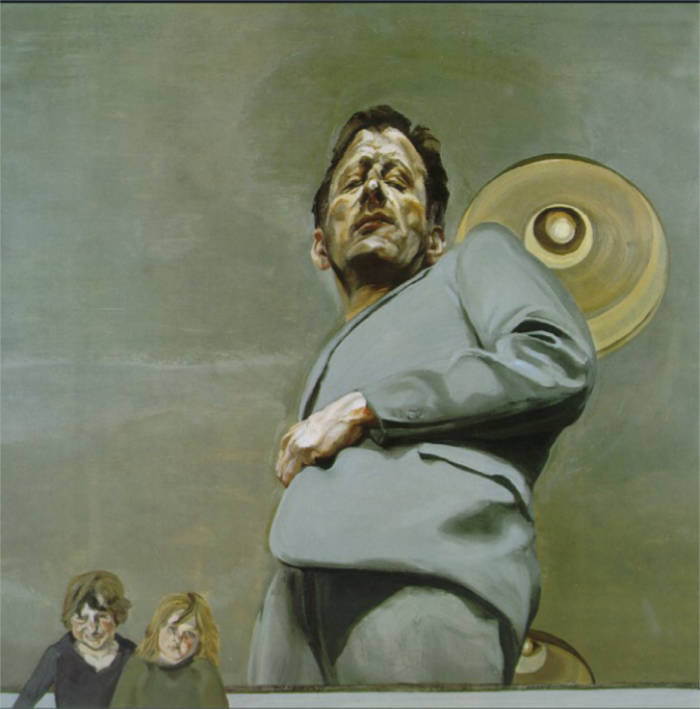
In his later years, Freud continued to produce significant works, including a series of self-portraits that delved into the themes of aging and mortality. These paintings are characterized by their introspective nature and the artist’s unflinching examination of his own image.
During his later year Freud painted portraits of many famous individuals such as the artist David Hockney, the art critic Martin Gayford, and Queen Elizabeth II.
Lucian Freud’s Last Years
2002 saw Tate Britain marked Freud’s 80th birthday with a major retrospective exhibition. Also, that year the British magazine Tatler listed the octogenarian as the second most eligible bachelor in the nation. A fact confirmed when shortly afterwards supermodel Kate Moss expressed her desire to meet him. A close friendship developed between them. Freud painting her portrait and tattooing two swallows on her lower back, a skill he had learnt in the merchant navy.
Lucian Freud continued to work up to his death from bladder cancer. He passed away on 20 July 2011 at the age of 88 and was buried in Highgate Cemetery in London.
Lucien Freud’s legacy endures through his meticulous technique, profound insights and his dogged commitment to portraying the human form with honesty and depth. All of which demonstrated his profound understanding of the human condition.
In his only piece of writing on his own art, Freud wrote that “A painter must think of everything he sees as being there entirely for his own use and pleasure”, a principle he appeared to live by for the whole of his life.

RELATED VIDEOS
Francis Bacon
Artwork

Leave A Comment